Overview
The Super Mario Galaxy Movie is a 2026 American animated adventure comedy based on Nintendo's Mario video game franchise. Directed by Aaron Horvath and Michael Jelenic from a screenplay by Matthew Fogel, it is the sequel to The Super Mario Bros. Movie (2023) and the second feature in the Illumination–Nintendo film partnership. It premiered at the Minami-za theatre in Kyoto on 28 March 2026 and was released theatrically in the United States on 1 April 2026 by Universal Pictures. It runs 98 minutes.
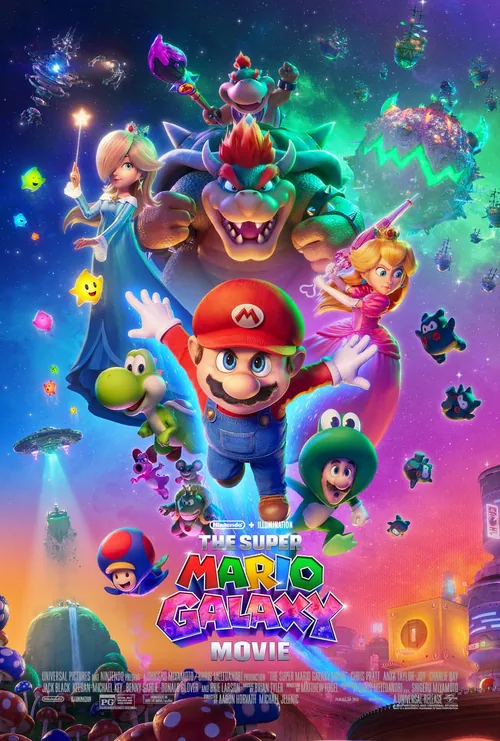
The film sends Mario, Luigi, Peach, Toad and their new dinosaur friend Yoshi into outer space, where they must rescue Rosalina from Bowser Jr. and prevent a weapon capable of destroying the universe. It draws primarily on Super Mario Galaxy (2007) and Super Mario Galaxy 2 (2010), while also borrowing characters and ideas from Super Mario Odyssey, Star Fox and Super Mario Bros. 2. Chris Pratt, Anya Taylor-Joy, Charlie Day, Jack Black and Keegan-Michael Key reprise their roles, joined by Benny Safdie as Bowser Jr., Donald Glover as Yoshi, Glen Powell as Fox McCloud and Brie Larson as Rosalina.
With a reported budget of $110 million, the film grossed about $1.013 billion worldwide, making it the fifth-highest-grossing film of 2026 and the second-highest-grossing video-game adaptation of all time, behind only its predecessor. Its critical reception was considerably cooler than its commercial performance: sources describe the response as mixed to negative, with an IMDb user rating around 6.2/10 and a Metascore of 37. That gap between audience turnout and critical approval is the central story of the film's release.
This article is an independent reference work. It draws on encyclopaedic and database sources, with links to the original material. Plot details are discussed openly in the story section, which is marked as containing spoilers.
Quick facts
- Directors
- Aaron Horvath, Michael Jelenic
- Writer
- Matthew Fogel
- Producers
- Chris Meledandri, Shigeru Miyamoto
- Release
- 1 April 2026 (US); 28 March Kyoto premiere
- Runtime
- 98 minutes
- Studios
- Illumination, Nintendo
- Distributor
- Universal Pictures
- Music
- Brian Tyler
- Budget
- $110 million (reported)
- Worldwide gross
- ~$1.013 billion
- Certificate
- PG (IMDb listing)
- IMDb
- tt28650488
- Based on
- Super Mario Galaxy / Galaxy 2
- Sequel to
- The Super Mario Bros. Movie (2023)
Source material and franchise background
From arcade plumber to cosmic adventure
Nintendo's Mario franchise began in 1981 with Donkey Kong and became a global phenomenon with Super Mario Bros. in 1985. Over four decades it has expanded into dozens of genres, but its central image remains simple: a moustachioed plumber jumping across platforms to rescue a princess and defeat a dragon-like villain. That simplicity is deceptive. The series has continually reinvented its settings — deserts, beaches, haunted houses, cities, museums — while keeping a small set of characters instantly recognisable.
Super Mario Galaxy, released for the Wii in 2007, was one of the franchise's most ambitious reinventions. Instead of flat worlds, it placed Mario on small spherical planets orbiting a central observatory, using the Wii Remote to aim and collect stars. Its sequel in 2010 added Yoshi and new mechanics. Both games are known for an unusually emotional tone: the Comet Observatory, the Lumas, and Rosalina's story about loss and motherhood gave the series a mythic dimension rare in platform games.
What the film adapts
The film takes its title and its main visual idea from those games: space, planets, the Comet Observatory and Rosalina. It also draws on Super Mario Odyssey (2017) for the Tostarena Town sequence, Star Fox for Fox McCloud and the Arwing, and Super Mario Bros. 2 for the casino owner Wart. This mix is significant. Rather than adapting one game literally, the screenplay assembles a greatest-hits tour of Nintendo's worlds — a strategy that pleases some fans and frustrates others who expected a tighter Galaxy adaptation.
Rosalina is the key inheritance. In the games she is a mysterious, gentle guardian of the Lumas with a quiet backstory; the film makes her Peach's long-lost older sister and gives the two women a shared cosmic power. That decision is the film's biggest interpretive leap, and one of the most debated aspects of its reception.
Development
Announcement and returning team
Nintendo president Shuntaro Furukawa said in May 2021 that the company was interested in making more animated films based on its properties if the first Mario film succeeded. Illumination CEO Chris Meledandri was asked about a sequel before The Super Mario Bros. Movie even opened in April 2023. After that film became the highest-grossing video-game adaptation ever, a new Mario film was officially announced in March 2024, with Aaron Horvath and Michael Jelenic returning as directors and Matthew Fogel as screenwriter.
Chris Meledandri and Shigeru Miyamoto produced. Miyamoto's involvement matters: he is the creator of the Mario franchise and a hands-on supervisor of its adaptations. The production was a joint effort between Illumination, known for the Despicable Me films, and Nintendo, with Universal Pictures distributing. That partnership had already produced one enormous hit; the second film was expected to consolidate the model.
Casting and performance
Chris Pratt, Anya Taylor-Joy, Charlie Day, Jack Black and Keegan-Michael Key all returned. Their performances in the first film had divided audiences — particularly Pratt's Mario — but the voices were now established for a new continuity. New cast members included Benny Safdie as Bowser Jr., Donald Glover as Yoshi, Glen Powell as Fox McCloud and Brie Larson as Rosalina. The casting strategy leaned on recognisable screen and comedy talent rather than impersonation, continuing the first film's approach.
Yoshi's inclusion was particularly notable. In the games, Yoshi is famously nonverbal, communicating through squeaks and expressions. Giving him Donald Glover's voice was a deliberate choice to make him a character in a dialogue-driven comedy — one that drew both praise for its warmth and criticism from fans who prefer the character's wordless charm.
Plot
Spoiler notice: this section describes the complete plot, including the ending.
Rosalina's abduction and the Luma's plea
The story opens in space. Rosalina, adoptive mother of the Lumas who live in the Comet Observatory, is kidnapped by Bowser Jr., who intends to steal her powers to fuel a universe-destroying cannon in honour of his defeated father. Bowser himself has been shrunk and humiliated by Mario and Luigi after the events of the previous film. Meanwhile, Mario and Luigi are called to investigate a disturbance in Tostarena Town, where they meet Yoshi — a dinosaur hatched in Brooklyn who was pursued back to his home world after breaking a skeleton in a museum.
A Luma crash-lands in the Mushroom Kingdom and asks Peach and Toad to help find Rosalina. With the two of them absent, Mario, Luigi and Yoshi are left to protect the kingdom and, improbably, attempt to rehabilitate Bowser.
Cosmic chase and shifting loyalties
Bowser Jr. lifts Peach's castle into space to free his father, but a battle with the brothers and Yoshi sends his spaceship crashing into the Honeyhive Galaxy, destroying the castle. Bowser goads Mario into attacking him, which restores his full size, but instead of fighting he offers to take responsibility for the damage in exchange for the others being transported to the Gateway Galaxy. He is later rescued by his son, who had been sent to boarding school years earlier — a detail that reframes Bowser Jr.'s motivation as a child's desire for paternal approval.
In the Gateway Galaxy, Toad's backpack is stolen by Ukiki, a monkey thief, and taken to a hidden casino. Peach confronts Wart, the casino's owner, and learns that Rosalina is in the Space Junk Galaxy — but Wart alerts the Bowsers. The group reunites and recruits Star Fox pilot Fox McCloud, whose Arwing is shot down by Bowser and his son. The villains use a Super Scope to turn Mario and Luigi into babies; Yoshi recovers the weapon, rescues the brothers from a Tyrannosaurus and restores them.
The Comet Observatory and the reveal
The Lumas bring everyone to the Comet Observatory, where Peach learns that she and Rosalina are long-lost sisters made from stardust. When they touch hands, they can summon cosmic power. Rosalina had sent the young Peach to the Mushroom Kingdom through a warp pipe to protect her from hostile forces. The reveal reinterprets the entire Mario mythology: the princess and the guardian are two halves of the same celestial story.
The final confrontation takes place on Planet Bowser. Mario collapses a bridge, dropping Bowser into lava, from which he survives as a skeletal form. Luigi and Yoshi help defeat the Bowsers with power-ups, and Mario saves Bowser Jr. when one of his own creations turns on him. Peach revives a dying Rosalina, and together the sisters terraform Planet Bowser into a new world. Back in the Mushroom Kingdom, everyone helps rebuild Peach's castle; Peach kisses Mario; Fox sends the Bowsers to prison and returns home. The film ends with Ukiki foiled again by Princess Daisy at the Gateway Galaxy.
Voice cast
| Performer | Role | Notes |
|---|---|---|
| Chris Pratt | Mario | Brooklyn-born plumber and hero |
| Anya Taylor-Joy | Princess Peach | Ruler of the Mushroom Kingdom; Rosalina's sister |
| Charlie Day | Luigi | Mario's younger twin brother |
| Jack Black | Bowser | King of the Koopas and former villain |
| Keegan-Michael Key | Toad | Mushroom Kingdom attendant |
| Benny Safdie | Bowser Jr. | Bowser's son and Rosalina's kidnapper |
| Donald Glover | Yoshi | Friendly green dinosaur |
| Glen Powell | Fox McCloud | Star Fox pilot |
| Brie Larson | Rosalina | Guardian of the Lumas |
Themes and interpretation
Family, inheritance and the need for approval
The film's emotional core is not Mario and Peach but Bowser and his son. Bowser Jr.'s scheme is an attempt to impress a father he barely knows; Bowser's arc is about reconciling his public identity as a villain with private responsibility as a parent. This gives the story an unexpectedly domestic shape: a child acts out, a parent makes a bad choice, and both are given a way back. For a franchise built on simple hero-villain opposition, that complexity is notable.
Peach and Rosalina: power and sisterhood
The revelation that Peach and Rosalina are sisters made from stardust is the film's boldest interpretive choice. It turns two separately iconic characters into complementary halves of a cosmic family, and it places female cooperation — not rescue — at the centre of the climax. Their joined power literally rebuilds a destroyed world. Critics who disliked the film often pointed to this reveal as an invention too far from the games; supporters saw it as the screenplay's most imaginative idea.
Adaptation and the appetite for recognition
The movie is dense with references: Tostarena, the Comet Observatory, Ukiki, Wart, the Star Fox Arwing, the Super Scope, power-ups, the Honeyhive Galaxy. For fans, these are rewards; for newcomers, they can feel like a checklist. The film never quite decides whether it is retelling Galaxy or celebrating the whole franchise. That tension explains much of the divided response — the same detail that delights one viewer can exhaust another.
Redemption and second chances
Bowser is given multiple opportunities to choose differently, and Mario repeatedly saves him or those close to him. The film's position is that even a humiliated villain can be something more than his role. That theme connects to the sequel structure: the first film ended with Bowser defeated and diminished; the second asks what comes after defeat. The answer is not a clean conversion but a messier, more human process.
Wonder and scale
Visually, the film is built around awe. Planets, star fields, cosmic observatories and enormous transformations give the animation a sense of scale the first film did not attempt. The Galaxy games were famous for making players feel small in a beautiful universe; the movie translates that by placing characters against vast animated backdrops, then cutting quickly to comedy. The tonal swing between wonder and slapstick is one of the film's defining habits.
Animation and visual design
Illumination's animation style is known for expressive faces, bright surfaces and fast comic timing. The Galaxy setting pushed the studio toward more complex environments: spherical worlds, nebula-like skies, star particles and a wide range of alien architectures. The Comet Observatory is rendered with a soft, storybook quality, while the Space Junk Galaxy and Planet Bowser lean into rougher, more metallic textures. The contrast gives the film visual variety even when the plot moves quickly.
Character design had to reconcile game models with the established look of the first film. Mario, Peach and Bowser keep the rounded, toy-like proportions audiences recognised from 2023. Rosalina's gown and hair required a different approach, mixing her game silhouette with the film's lighting style. Yoshi's design is perhaps the most successful translation: he is recognisably the game character, but his face is given enough range to carry a comic performance.
Editing is credited to Eric Osmond. The film's 98-minute runtime keeps the pace brisk, but the density of planets, characters and callbacks means that several sequences move quickly. This is one of the practical consequences of adapting a game series known for exploration into a tight family feature: the audience is shown a great many worlds, but does not linger in them.
Music
The score was composed by Brian Tyler, whose work is known for large orchestral arrangements and strong thematic development. For a film about space, heroism and family revelation, that approach fits: the music gives cosmic sequences weight and gives the quieter Bowser–Bowser Jr. scenes a more intimate register. Tyler's score also has to coexist with the franchise's musical identity, including the brassy motifs audiences associate with Mario's jumping and power-ups.
Mario films face a particular challenge: the games' soundtracks are among the most recognisable in popular culture, and any score that ignores them risks feeling disconnected from the source. The film uses orchestral arrangement rather than direct imitation, quoting the spirit of Koji Kondo's themes while allowing Tyler's own melodies to carry the emotional arcs. The result is less catchy than the Galaxy games' music but better suited to a feature-length structure.
Sound design is central to the comedy. Yoshi's vocalisations, Toad's reactions and the mechanical noise of the Space Junk Galaxy create a busy acoustic world, while the vastness of space is conveyed by moments of near-silence before a musical swell. That contrast between emptiness and abundance mirrors the film's visual design.
Release and marketing
The Super Mario Galaxy Movie premiered at the historic Minami-za theatre in Kyoto on 28 March 2026 — a pointed choice for a film adapted from a Japanese game franchise — and opened in the United States on 1 April through Universal Pictures. The release date placed it in the early spring family market, away from the crowded summer season, and gave it a long run before the school holidays.
Marketing leaned on spectacle and recognition. Trailers showed the Comet Observatory, Rosalina, Yoshi and Bowser Jr., promising a bigger adventure than the first film. The poster presented an almost overwhelming array of characters around Mario, signalling that the sequel would widen the franchise rather than narrow it. tie-ins with Nintendo's game catalogue and themed merchandise extended the campaign into the same retail spaces the films' target audience already knew.
The film was rated PG in the United States, consistent with its family-adventure positioning. Its marketing did not foreground the critical reception; by the time reviews appeared, ticket sales were already strong. That sequence — huge opening, cooler reviews, sustained audience interest — became the defining pattern of the release.
Box office
On a reported budget of $110 million, the film grossed approximately $1.013 billion worldwide. That made it the fifth-highest-grossing film of 2026 and the second-highest-grossing video-game adaptation ever, trailing only The Super Mario Bros. Movie. The result confirmed that the first film's success was not a one-off and that a well-known game franchise with broad family appeal could sustain a theatrical series.
The commercial pattern was notable for its resilience. Even with mixed-to-negative critical response, the film benefited from name recognition, a relatively modest budget by modern blockbuster standards and a release window with limited family competition. Audiences who grew up with the games brought children who had never seen the original film in cinemas, and repeat viewing appears to have been strong in the opening weeks.
Box-office figures vary between databases as runs conclude in different territories, so the total should be treated as a reported estimate. The broader conclusion is not in doubt: the film was a major commercial success by any reasonable measure.
Critical reception
Critical response was, by most accounts, mixed to negative. IMDb lists a user rating of about 6.2/10 from roughly 80,000 votes, while the Metascore sits at 37 — a substantial gap that reflects the difference between general audience enjoyment and professional assessment. Reviewers who responded positively praised the animation, the sense of scale and the film's willingness to give Rosalina and Peach a story of their own.
The criticisms were consistent. Some found the screenplay overstuffed, arguing that too many game references competed for attention and that the emotional beats arrived without enough setup. Others objected to the Peach–Rosalina sister reveal, either as a departure from canon or as a shortcut to emotional weight. The Bowser storyline was praised for ambition but criticised by those who felt the character had been softened beyond recognition.
The audience response was warmer. For families, the film delivered exactly what its marketing promised: a colourful, fast-moving adventure with familiar characters and a clear hero's journey. The gap between critics and audiences is a useful reminder that adaptation fidelity and entertainment value are different measures. A film can be commercially triumphant and critically contested at the same time — and this one was both.
“The movie's greatest strength and its greatest weakness are the same thing: it wants to contain the entire Mario universe in ninety-eight minutes.”
Debates and open questions
Faithful adaptation or fan-service collage?
The biggest debate concerns the film's relationship to the games. Super Mario Galaxy has a specific story, setting and emotional tone; the movie uses its imagery but tells a different story, adding characters from several other Nintendo series. Fans who wanted a direct adaptation were disappointed. Others argued that a feature film has different requirements and that recognisable elements matter more than literal plot fidelity.
The Peach–Rosalina reveal
Making Rosalina Peach's long-lost older sister was the film's most discussed invention. It gives both characters a shared cosmic origin and a powerful climax, but it also rewrites decades of game lore. For some viewers, that is a bold and welcome expansion; for others, it is a decision made for emotional impact rather than narrative truth. The disagreement is likely to persist because the games never confirmed or denied such a relationship.
Bowser's redemption arc
Bowser has always been a comic villain as well as a threat, but the film pushes him further toward sympathy. Jack Black's performance gives him warmth and insecurity, and Bowser Jr.'s need for approval makes the family dynamic central to the story. Critics who disliked the shift argued that a villain without menace leaves the hero without a challenge; supporters saw it as a mature evolution of a character who had already been humiliated in the first film.
Yoshi's voice
Yoshi's silence in the games is part of his charm, so casting Donald Glover to give him dialogue was always going to divide opinion. In practice, the film uses Yoshi as the emotional and comic bridge between the brothers and the wider space adventure. Whether that justifies changing a defining characteristic depends on how much weight a viewer gives to fidelity versus the demands of an ensemble comedy.
Critical versus audience response
The film's reception raises a broader question about video-game adaptations: should they be judged primarily as adaptations or as films? Reviewers who treated it as a film found the pacing and script wanting; audiences who approached it as a celebration of beloved characters were more forgiving. Both responses are legitimate, and the gap explains the unusually wide spread between the Metascore and user ratings.
Franchise context and the future
The film follows The Super Mario Bros. Movie (2023), which grossed over $1.3 billion and became the highest-grossing video-game adaptation at the time. That film had proved that an animated Mario feature could work on a global scale; the sequel had to prove it was a franchise rather than a novelty. Its billion-dollar result did that, even if the reviews were less enthusiastic.
Nintendo's approach to its catalogue has changed markedly in recent years. Alongside films, the company has released theme-park areas, merchandise lines and new games built around characters with decades of history. Mario is no longer only a game character; he is a transmedia brand. The Galaxy film is a product of that strategy — a movie that exists as much to keep the franchise visible between game releases as to tell a self-contained story.
No third film had been confirmed at the time of writing. Given the box office, further instalments are plausible, but the mixed critical response may encourage the producers to rethink how much material they pack into a sequel. The Galaxy games are rich enough to support a more focused adaptation if the studio chooses one. For now, the film stands as a big, brave, uneven attempt to bring a beloved cosmic corner of the Mario universe to the big screen.
Character focus
Mario and Luigi: the brothers at the centre
Mario remains the emotional constant: brave, impulsive and unfailingly kind. The sequel gives him a different challenge from the first film. Instead of proving himself as a hero, he must respond to a villain who has already been defeated and humiliated. Luigi, meanwhile, continues to provide the franchise's anxious counterweight. Charlie Day's performance leans into fear and loyalty, and the baby-Luigi sequence lets the film revisit the brothers' childhood dynamic without losing the adult emotional stakes.
Bowser and Bowser Jr.
Benny Safdie's Bowser Jr. is the film's driving force. His plan is grand, but its motivation is small and recognisable: he wants his father back in his life. Jack Black's Bowser, reduced in size and status at the start, is given room to be funny, bitter and finally protective. The two actors play off each other with a rhythm that makes the family storyline the most coherent part of the screenplay.
Rosalina and Peach
Brie Larson's Rosalina carries the film's mythic weight. She is less a character with a arc than a figure of memory and guardianship — a role that fits the games but gives an actor limited room for conflict. Anya Taylor-Joy's Peach has the more active part, moving from ruler to investigator to cosmic partner. Together they create the film's most striking images, and their climax is the moment the screenplay's ambition is clearest.
Yoshi and Fox McCloud
Yoshi functions as the film's comic heart, a creature whose innocence disarms both the heroes and the villains. Fox McCloud, voiced by Glen Powell, is a self-contained joke for anyone who knows the Star Fox games: a serious mercenary pilot dropped into a Mario story. His Arwing sequence adds a different kind of action to the film, using aerial combat to break up the planet-hopping structure.
Comparison with the first film and the games
The Super Mario Bros. Movie was a tightly built origin story: Brooklyn plumbers, a race to save the Mushroom Kingdom, and a final confrontation with Bowser. Its sequel is looser and more episodic. Rather than one clear objective, the film moves through a sequence of locations — Tostarena, the Honeyhive Galaxy, the Gateway Galaxy, the casino, Fossil Falls, the Comet Observatory, Planet Bowser — each introducing or recalling a different part of the franchise.
That structure is closer to the games than the first film was. Super Mario Galaxy is itself organised as a series of small worlds connected by a hub, so the movie's planet-hopping has a logical source. The difference is that games allow players to linger; a 98-minute film must keep moving. The result feels less like a single adventure than a guided tour, which is both the source of its charm and the root of the criticism that it is overstuffed.
Tonally, the sequel is more willing to be strange. The first film kept its comedy broad and its emotions simple. The second introduces a cosmic birth story, a villain with daddy issues, a dinosaur with a voice, and a princess who discovers she is made of stardust. That is a much stranger mix — and probably why the critical response was so much less uniform. A film that takes more risks with its source material invites more arguments about whether those risks paid off.
Production notes
The film was produced by Illumination and Nintendo, with Universal Pictures handling distribution. Chris Meledandri and Shigeru Miyamoto served as producers, a pairing that reflects the commercial and creative stakes on both sides. Eric Osmond edited the film. The production had to manage an unusually large cast of recognisable characters, each with a distinct visual design and a fan base that would scrutinise the result.
The decision to premiere in Kyoto was more than ceremonial. Japan is the home of Nintendo and of the Galaxy games, and holding the premiere at the Minami-za theatre acknowledged that origin. The American release followed four days later, close enough to maintain momentum but separate enough to give the film two distinct launch moments.
The reported $110 million budget is modest compared with many contemporary blockbusters, which helps explain why a billion-dollar gross was so commercially emphatic. Much of the cost went into animation and the rendering of large cosmic environments, while the star voices and global marketing campaign accounted for the rest. The film's financial success gives Nintendo and Illumination considerable freedom in deciding what a third instalment might be.
Worlds and visual motifs
The film's settings are drawn from a franchise that has always treated geography as a sequence of ideas. Tostarena Town from Odyssey introduces a desert with steep, sun-baked architecture and a puzzle-box quality. The Honeyhive Galaxy is golden and organic, built around hexagonal patterns and warm light. The Gateway Galaxy functions as a transit hub, a place of thresholds where Ukiki's casino can hide in plain sight. Fossil Falls introduces a prehistoric world of bone and stone, and the Comet Observatory is the film's emotional anchor: a floating home filled with small, round Lumas who move like curious children.
Planet Bowser is the visual culmination. It begins as a hostile, volcanic world shaped around its creator's resentment and is transformed at the end into a living landscape. That transformation is the film's most literal image of its theme: a place built from anger can be remade through care. The animation team uses a palette shift to signal this — harsh reds and blacks early on, softer greens and blues after Peach and Rosalina intervene.
Recurring motifs reinforce the connection between games and film. Stars appear everywhere: in the sky, on power-ups, in Rosalina's designs, and in the film's title treatment. Spherical planets echo the Galaxy games' central mechanical idea. Tubes and portals recall the warp pipes of the original games, now expanded into a cosmic transportation system. Even the smaller details — Toad's backpack, the Super Scope, a casino run by Wart — function as visual shorthand for long-time players.
The density of these references is both a strength and a weakness. A viewer who recognises them is rewarded repeatedly; a viewer who does not may feel the film is moving from one inside joke to the next. That double address is typical of modern franchise cinema, but it is especially pronounced here because Nintendo's games have such a deep visual vocabulary. The film rarely pauses long enough for an unfamiliar child to ask what a place is before the story moves on — a practical consequence of fitting so many worlds into 98 minutes.
Sources and further reading
- Wikipedia — The Super Mario Galaxy Movie: credits, plot, release, budget, box office and reception.
- IMDb — tt28650488: rating, runtime, certificate and key art.
- IGN — The Super Mario Galaxy Movie: key art and film background.
- Nintendo: official information on the Mario franchise and related games.
- Illumination: official studio information.
Editorial note: this is an independent reference article. It is not affiliated with Nintendo, Illumination, Universal Pictures or the film's rights holders. Image credits and the removal process are described on the DMCA page.
Frequently asked questions
What is The Super Mario Galaxy Movie?
It is a 2026 animated adventure comedy from Illumination and Nintendo, and the sequel to The Super Mario Bros. Movie. Mario and his friends travel into space to rescue Rosalina and stop Bowser Jr.
When was it released?
The film premiered in Kyoto on 28 March 2026 and was released in the United States on 1 April 2026.
Who directed it?
Aaron Horvath and Michael Jelenic directed the film. Matthew Fogel wrote the screenplay, and Chris Meledandri and Shigeru Miyamoto produced it.
Which games is it based on?
Primarily Super Mario Galaxy and Super Mario Galaxy 2, with elements from Super Mario Odyssey, Star Fox and Super Mario Bros. 2.
Who voices the main characters?
Chris Pratt is Mario, Anya Taylor-Joy is Peach, Charlie Day is Luigi, Jack Black is Bowser, Keegan-Michael Key is Toad, Benny Safdie is Bowser Jr., Donald Glover is Yoshi, Glen Powell is Fox McCloud and Brie Larson is Rosalina.
How long is the film?
The running time is 98 minutes.
Who composed the music?
Brian Tyler composed the score.
How much did the film earn?
Reported worldwide gross is approximately $1.013 billion against a reported $110 million budget, making it the second-highest-grossing video-game film ever.
What did critics say?
Response was mixed to negative. Reviewers praised the animation and scale but criticised the crowded script and some adaptation choices. IMDb users rated it around 6.2/10.
Is another Mario film planned?
No third film had been officially confirmed at the time of writing, though the box-office performance makes further instalments plausible.
Is this website official?
No. This is an independent informational reference site with no affiliation to Nintendo, Illumination, Universal or the filmmakers. Sources and an image-removal process are provided on the DMCA page.
Community
Join the discussion
Have a thought about the film or this article? Leave a comment. Your name is displayed, and if you add a website it will be linked with a
nofollowattribute. Basic HTML is supported:<p>,<strong>,<em>,<a>, lists and blockquotes.Comments update live. New posts appear automatically without refreshing.
No comments yet. Be the first to start the conversation.
By commenting you agree to the Terms of Use. See the Privacy Policy for how your data is handled.